



Guidelines for sourcing images
When you want to enhance a presentation with imagery but do not have the time, budget or expertise to create your own, you will probably use stock photography or illustration. While ANZCA encourages the use of stock imagery, you should only use sourced images if you have all the necessary rights and permissions and are not infringing on a trademark or licence. It is your responsibility to ensure the photos you place in your presentation are sourced correctly, as using imagery without the correct permissions can lead to expensive fines.
Finding quality, free stock images:
There are many great sites on which you can find royalty-free stock images. Below are some of our top sites for free stock photography:
- Unsplash
- High-resolution photos contributed by photographers worldwide.
- Great for artistic and natural-looking images.
- License: Free for personal and commercial use, no attribution required.
- Visit Unsplash
- Pexels
- Offers a wide range of free images and videos
- Includes a search feature for finding images by theme colour.
- License: Free for personal and commercial use, no attribution required.
- Visit Pexels
- Pixabay
- Huge library of photos, illustrations, vectors and videos.
- Particularly useful for projects needing diverse media.
- License: Free for personal and commercial use, no attribution required.
- Visit Pixabay
- Freepik
- Provides photos, vectors, and PSD files.
- Some resources require attribution unless you subscribe to the premium service.
- Great for designs and creative projects.
- Visit Freepik
- Burst (by Shopify)
- Focused on business and marketing images, ideal for e-commerce.
- High-quality, curated collections for entrepreneurs.
- License: Free for personal and commercial use, no attribution required.
- Visit Burst
- StockSnap.io
- Weekly additions of free photos, including trending searches.
- No attribution required for images.
- Excellent for contemporary and lifestyle photography.
- Visit StockSnap.io
- Gratisography
- Quirky and fun high-resolution images with a creative twist.
- Ideal for projects requiring a unique aesthetic.
- License: Free for personal and commercial use, no attribution required.
- Visit Gratisography
- Life of Pix
- Artistic and detailed high-resolution images.
- Contributions from photographers around the world.
- License: Free for personal and commercial use, no attribution required.
- Visit Life of Pix
- ISO Republic
- High-quality images and videos for creatives.
- Categories range from abstract to lifestyle.
- License: Free for personal and commercial use, no attribution required.
- Visit ISO Republic
- Reshot
- Focused on non-stocky images to stand out in creative projects.
- Curated collection aimed at startups and freelancers.
- License: Free for personal and commercial use, no attribution required.
- Visit Reshot
Tip: Always download the image in the largest possible resolution, rather than copying or snipping it. This will ensure you have a clear picture that will look great on a large screen.
Using Google:
Before you reuse content, make sure that its license is legitimate and check the exact terms of reuse. For example, the license might require that you credit the image creator when you use the image.
We recommend that you:
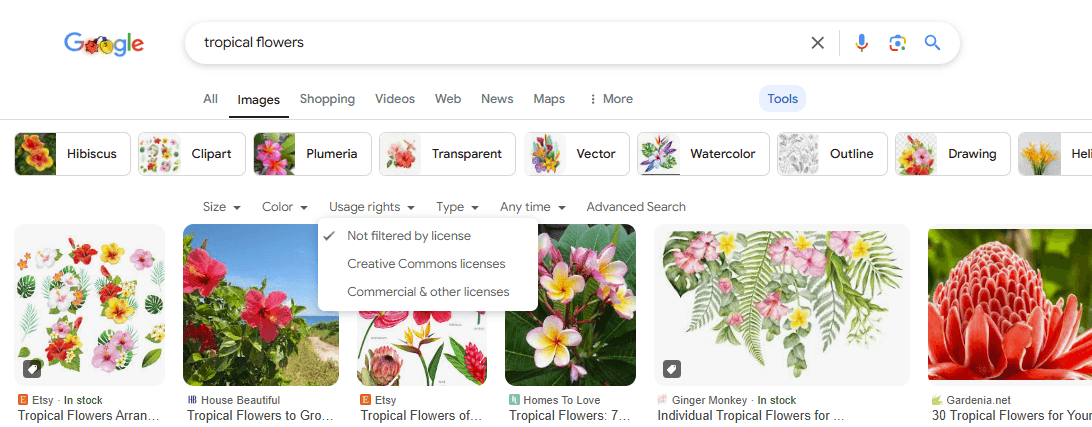
- Use the usage rights filter to find images with license information attached to them. Google filters images by license based on information provided by the sites that host those images or the image provider.
- Always confirm an image’s license information. You can follow the “license details” link and review it for accuracy with both the license’s provider and the image’s host site.
To find license details: Select an image, then below the image, select license details. We recommend that you always review the licensing requirements of any images you want to use.
Creative commons licenses: These images are usually available at no charge to use but require credit. They may also have limitations on how, or in what context, you can use them. For example, an image’s license might state that you can’t modify it or use it for commercial purposes.
Commercial or other licenses: These images have non-creative commons licenses and can be from either sites available at no charge or commercial sites that require payment.
Other things to be mindful of when image sourcing:
Be aware of trademarks in image
Ensure your image doesn’t include a trademark that could suggest to your audience that the owner is endorsing or sponsoring you. For example, if you have a presentation about running marathons, don’t feature the Nike ‘swoosh’ in a way that could make someone think Nike is supporting or endorsing you. Think about how a similar situation could apply to you in the medical world.
Be aware of copyrights
Ensure your image doesn’t include copyrighted materials you don’t have permission to use. Even if you own a license for the image itself, parts of the image may have their own separate copyrights. For example, if you post a photo that includes a copyrighted painting, you could have permission from the photographer, but you might not have permission from the painter.
Take care when using people images
If you need an image of a person or people and didn’t take your own photo, first see if you can use something different. For example, to show employees in your office, it’s better to take photos of your actual staff with their permission. Alternatively, you could use images of your office that don’t include people or stock images related to your industry. Identifiable people in images may have the right to prevent their images from being published. Before you publish the image, ensure that everyone has given consent to having their image used publicly.
Credit the artist where appropriate
Consider if you should credit the artist. You can add a credit by inserting an image caption on the image with the proper wording. Some content, including stock imagery, is covered by terms that might require you to credit the artist; always check. If ever in doubt, do not use the image; move on to another image you know you have the right to use.
Reference: support.squarespace.com/hc/en-us/articles/360001994087
ANZCA recognises Te Tiriti o Waitangi as a foundational document that shapes the historical and cultural landscape of Aotearoa New Zealand and that informs our approach to medical education, research, and community engagement Tangata Whenua.
ANZCA acknowledges and respects Māori as the Tangata Whenua of Aotearoa and is committed to upholding the principles of the Treaty of Waitangi, fostering the college’s relationship with Māori, supporting Māori fellows and trainees, and striving to improve the health of Māori.
The college recognises the special relationship between the Pacific peoples of New Zealand, Australia and the Pacific, and is committed to supporting those fellows and trainees of ANZCA, and improving the health of Pacific peoples.